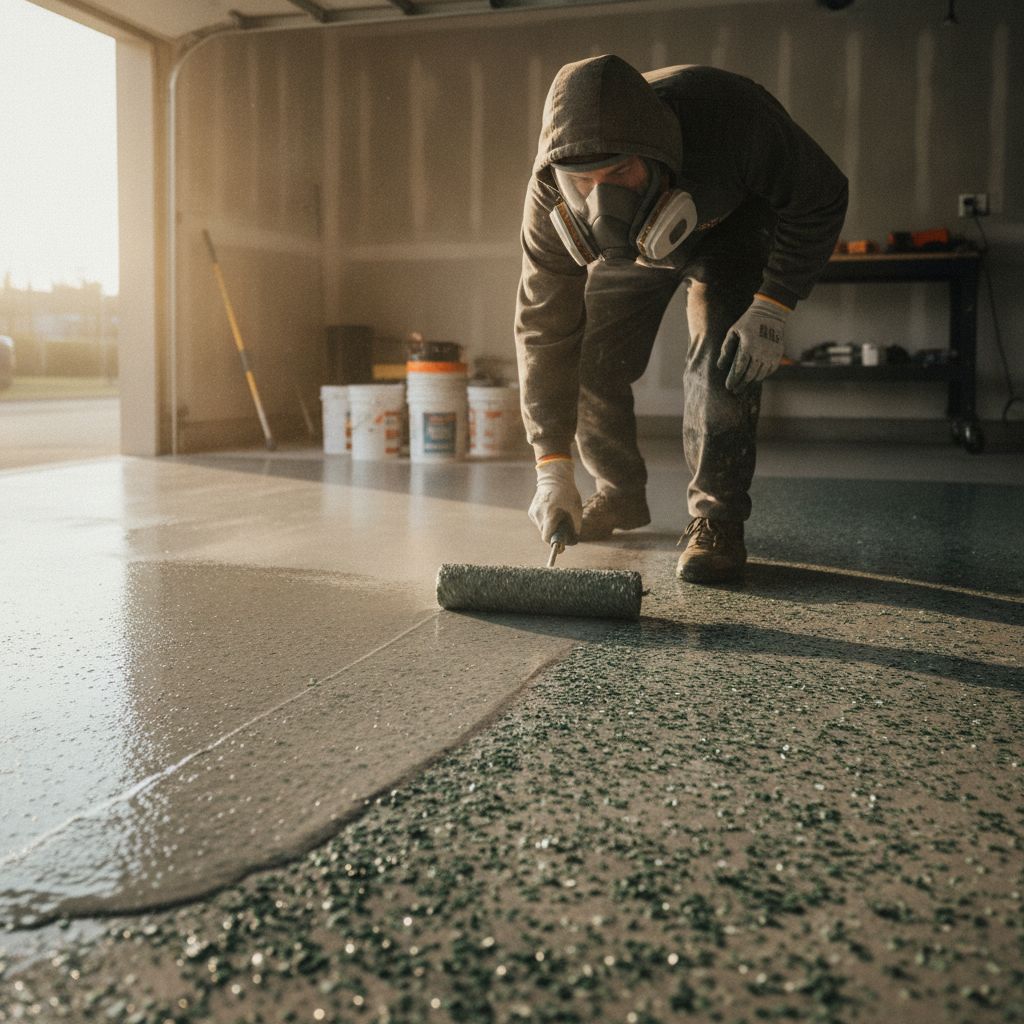
Search demand around here tells its own story: local search volume for "epoxy garage floor" runs well ahead of "polyurea garage floor" in the Las Cruces market — most homeowners start their research with epoxy in mind, simply because it's the more familiar term. But epoxy is also the system most likely to show visible wear within a few years under this valley's specific sun exposure.
Standard epoxy resin isn't formulated to hold up under sustained UV exposure. Garages that get direct sun through a window, or floors near an open garage door through Las Cruces' long, bright growing season, commonly show yellowing, chalking, or a dulled finish within a few years — sometimes faster than the coating's own warranty period.
Polyurea (and its close relative, polyaspartic) is a more UV-stable elastomer chemistry. It resists the yellowing and chalking that standard epoxy shows under prolonged sun exposure, and it stays flexible through the valley's day-to-night temperature swings instead of becoming brittle.
Windblown sand and farm dust from the surrounding agricultural fields are a daily fact of life in the Mesilla Valley, and a garage floor gets more foot- and tire-tracked grit than most rooms in the house. A properly installed polyurea topcoat resists the fine abrasive wear that sand and dust cause over years of daily use.
When we assess a garage in Las Cruces, sun exposure and direction are part of what we look at — not just square footage. Las Cruces Polyurea specifies the system to actually survive this valley's climate, not a generic national spec.
No obligation. We'll assess your space and give you a real number.